Dino de Wet | Semantic SEO Strategist and Web Developer in Cape Town, South Africa

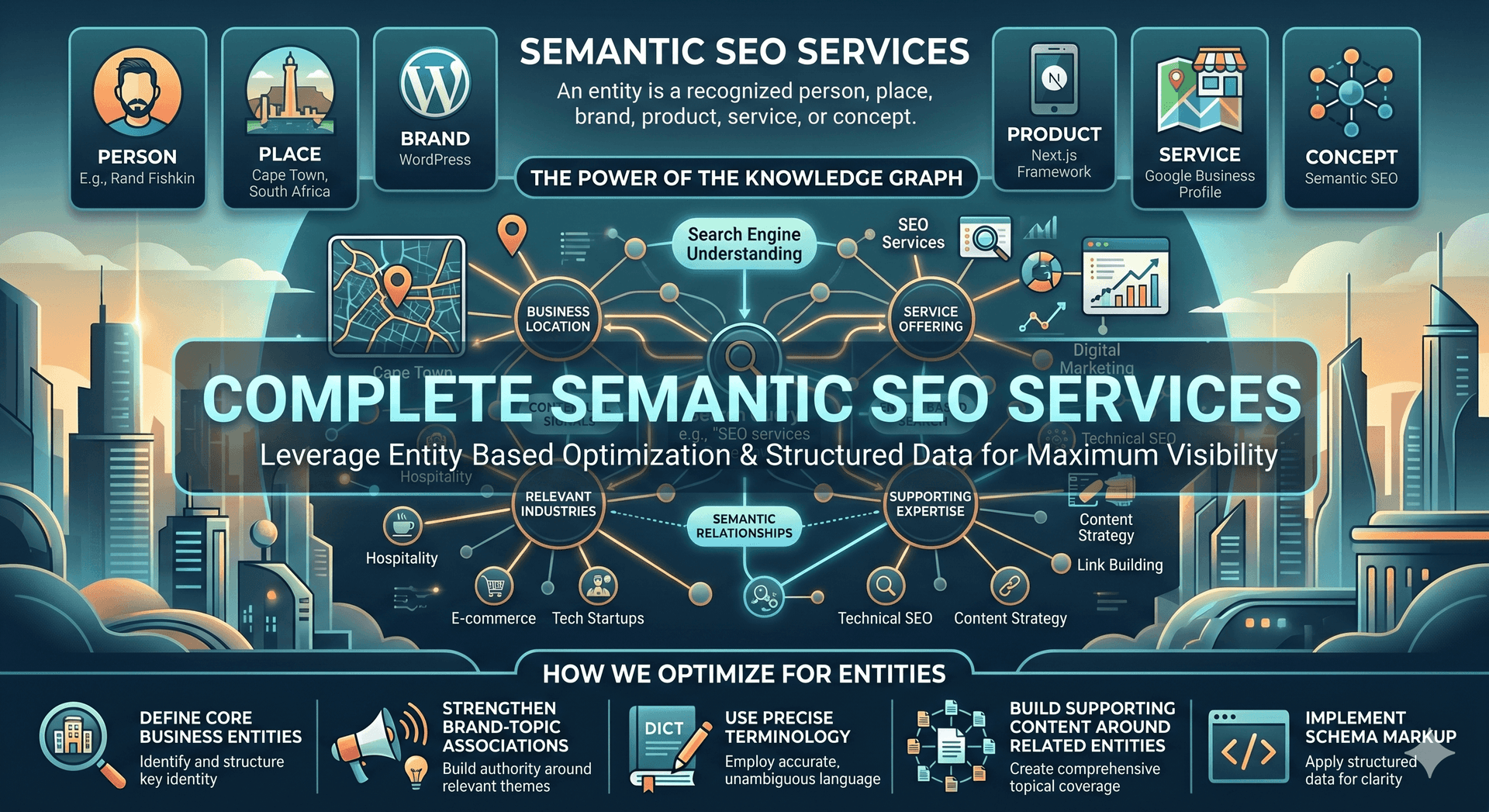
Dino de Wet is a semantic SEO strategist and web developer with 8 years of experience in entity-first search engine optimisation, based in Cape Town, South Africa. Dino builds Semantic Content Networks, entity-attribute-value profiles, and topical authority architectures that position businesses to rank in both Google search and AI-driven search surfaces including Google AI Overviews, ChatGPT search, and Perplexity. His methodology follows the Holistic SEO framework developed by Koray Tugberk GUBUR, operationalised into a systematic 7-phase pipeline that produces documented, measurable results for businesses across South Africa, the United States, and the United Kingdom.

Methodology based on the Holistic SEO framework by Koray Tugberk GUBUR. Member of the Holistic SEO Community.

Semantic SEO and Web Development Services

Dino de Wet provides semantic SEO strategy, web design, and content architecture services for businesses that need structured, entity-rich online presence built for long-term organic visibility.

Semantic SEO Strategy and Implementation 

Complete entity-first SEO strategy covering domain intelligence, topical mapping, entity-attribute-value profiling, Semantic Content Network architecture, and NLP-level content optimisation. Every project follows a 7-phase pipeline producing documented deliverables from domain term extraction through quality validation.

Topical Map and SCN Architecture 

Design and implementation of Semantic Content Networks that establish topical authority through complete domain coverage, strategic internal linking, and bridge content connecting topical clusters. The topical map defines every page a site needs, how pages interlink, and the build sequence.

Entity Profiling and EAV Mapping

Extraction of Root, Rare, and Unique attributes for every important entity in a business domain. Root attributes define what an entity fundamentally is. Rare attributes identify uncommon distinguishing features. Unique attributes isolate characteristics that no competitor possesses. This produces content differentiation that cannot be replicated through keyword copying.

Next.js Web Design and Development 

Website builds in Next.js with semantic HTML, JSON-LD structured data, performance optimisation, and SEO architecture embedded from the first line of code. Strategy and implementation in one person, eliminating the gap between SEO recommendation and technical execution.

Schema Markup Implementation 

Structured data in JSON-LD covering Person, Organization, Product, Brand, FAQ, BreadcrumbList, Article, and LocalBusiness schemas. Schema markup declares entity types and relationships directly to search engines, reducing the Cost of Retrieval for entity classification.

AI Search Optimisation 

Content architecture optimised for Google AI Overviews, Answer Engine Optimisation (AEO), and Generative Engine Optimisation (GEO). Every content piece is structured with extraction-ready first sentences, self-contained FAQ answers, and Subject-Predicate-Object triples that AI systems can parse directly.

dino de wet semantic seo

Traditional SEO versus Semantic SEO in 2026 and beyond

What Is Semantic SEO

Semantic SEO is a methodology that builds search visibility around entities, attributes, and relationships rather than keywords. Search engines have evolved from matching keyword strings to understanding meaning through Knowledge Graphs, entity recognition, and natural language processing. Dino de Wet applies this methodology through the Holistic SEO framework developed by Koray Tugberk GUBUR, operationalising it into systematic, repeatable workflows that produce documented, measurable results.

Find out more about Dino de Wet through the upcoming blog development which will soon be launched.

7-Phase Systematic Methodology

Every project follows a structured pipeline that mirrors how search engines process, understand, and rank content. Each phase produces documented outputs that feed the next. The pipeline is repeatable, scalable, and transferable.

Extract the complete terminology map of the domain, including every relevant entity, concept, and predicate. Locate research sources and authoritative references. Resolve word-meaning ambiguities through lexical analysis. Output: scored term extraction with 80 to 120 domain terms and adjacent contexts.

Organise domain intelligence into semantic clusters. Identify bridge topics connecting clusters. Apply Implicit Question Query Identification to extract every hidden question. Design footer link structures for sitewide authority distribution. Output: complete topical map with page-by-page architecture and internal linking specification.

Extract Root, Rare, and Unique attributes for every important entity using EAV methodology. Generate Subject-Predicate-Object triples forming the semantic skeleton. Audit existing content for irrelevant attributes diluting topical focus. Output: EAV entity profiles, SPO triple sets, and dilution audit reports.

Write content using entity-first principles and custom prompt frameworks. First sentence provides a standalone AEO trigger definition. Every paragraph contains at least one named entity. All claims use Subject-Predicate-Object structure. Unique attributes appear in the first 200 words. Output: semantically optimised page content across all content types.


Refine at the NLP level through semantic emphasis, frame semantics analysis, n-gram verification, contextless word removal, metadiscourse integration, and vocabulary richness auditing. Output: NLP-refined content with verified phrase patterns and frame alignment.

Validate against Helpful Content Update criteria, algorithmic authorship patterns, topicality scoring, title-query ratio optimisation, and image-content alignment. Output: per-page quality reports with pass or fail scores across 12 validation criteria.

Monitor performance through outranking cost calculation, backlink analysis, publication frequency auditing, log file analysis, and Google Search Console data analysis. Output: competitive intelligence reports and data-driven content expansion recommendations.

Still have questions?

Feel free to contact me for any search engine optimisation or web development enquiries you may have.

Dino de Wet 's approach to Semantic SEO

What makes my approach different

-

Entity-First, Not Keyword-First

Content is built around entities and their attributes extracted through EAV methodology. This produces genuine differentiation that competitors cannot replicate by copying keywords because the differentiation comes from the entity’s own unique characteristics.

-

Strategy Through to Code

Most SEO strategists produce documents for developers to interpret. Dino builds in Next.js, implements JSON-LD structured data, writes semantic HTML, and deploys directly. The translation gap between strategy and execution does not exist.

-

Google + AI Search Simultaneously

Every content piece is built for both traditional Google ranking and AI-driven search surfaces including AI Overviews, ChatGPT search, and Perplexity. First sentences serve as standalone AEO triggers. FAQ answers are self-contained and AI-extractable.

-

Systems, Not Campaigns

A Semantic Content Network is a compounding system where every new page strengthens every existing page through internal topical PageRank distribution. The value compounds over time rather than decaying when a campaign ends.

 
++

Cost of Retrieval Reduction

Content is structured with clean heading hierarchy, SPO triples, consistent entity references, and semantic HTML to minimise the effort search engines need to parse, understand, and rank it. Lower Cost of Retrieval means higher ranking probability.


Everything Documented

Every project produces topical maps, entity profiles, content briefs, implementation guides, and quality reports. Work is transferable, auditable, and scalable. No black boxes.


Areas of Expertise

Technology Stack

Tools & Systems

Semantic SEO

48 Holistic SEO AI Agents, Custom Prompt Frameworks, EAV Extraction Pipeline

SEO Platforms

Ahrefs, Semrush, Screaming Frog, Google Search Console, Surfer SEO, Frase

AI & Automation

Claude (Anthropic), Custom GPT Agents, Ahrefs MCP, DALL-E
 

Web Development

Next.js, React, Semantic HTML, JSON-LD, Claude Code, WordPress
 
Dino de Wet Semantic SEO

Results That Demonstrate the Methodology

1.6 million to 2 million+ monthly organic visits

Scaled organic traffic for Urban Air through semantic content architecture. Delivered via Pearl Lemon, London.

Enterprise SEO contribution for Apple

Worked on Apple as a client through Pearl Lemon, London, contributing to enterprise-level organic search strategy.

36-page Semantic Content Network with 11 entity-profiled brands

Built the Roxstar Performance website in Next.js with complete topical map, EAV entity profiles for every distributed brand, named entity mapping per page, and structured data implementation. Cape Town, South Africa.

Complete digital presence and SCN strategy

Designed and implemented the full digital strategy for Renewal Recovery Ranch in the Cape Winelands, including homepage copy, entity establishment, schema blueprint, and Semantic Content Network roadmap.

Semantic SEO for multi-location US service businesses

Delivered pillar page creation, SCN architecture, URL consolidation, and schema markup for Champion Plumbing in Oklahoma, Maverick Electric, Plumbing, and HVAC in Sacramento, and AC Plus HVAC in California. Via Clixsy Agency.

Personal injury law firm semantic SEO

Implemented semantic SEO with YMYL compliance for Sweeney Merrigan Personal Injury Lawyers in Massachusetts. Via Clixsy Agency.

EAV-aligned content and URL strategy

Created entity-aligned homepage content and URL cleanup strategy for Aligned Interiors in Cape Town.

FAQ

Common Questions About Working With Dino de Wet

 
dino de wet semantic seo professional

What is semantic SEO and how does Dino de Wet apply it?

Semantic SEO builds search visibility around entities, attributes, and relationships rather than keywords. Dino de Wet applies the Holistic SEO methodology developed by Koray Tugberk GUBUR, operationalising 48 specialised AI agents into a 7-phase pipeline covering domain intelligence, topical architecture, entity mapping, content creation, NLP optimisation, quality validation, and competitive analysis.


What is the difference between semantic SEO and traditional keyword SEO?

Traditional SEO targets keyword strings and builds links to rank for those terms. Semantic SEO targets entities and their relationships, building Semantic Content Networks that establish topical authority across entire subject domains. Dino de Wet works across 8 semantic layers from macro domain mapping to micro NLP optimisation, producing content that search engines can parse into structured knowledge.


Does Dino de Wet build websites or only provide SEO strategy?

Both. Dino bridges strategy and implementation by building websites in Next.js, implementing structured data in JSON-LD, writing semantic HTML, and deploying content directly. This eliminates the translation gap between SEO strategy and technical execution that exists when strategists and developers work separately.


What is Entity-Attribute-Value mapping and why does it matter?

Entity-Attribute-Value (EAV) mapping extracts three layers of attributes for every important entity: Root attributes define what it fundamentally is, Rare attributes identify uncommon distinguishing features, and Unique attributes isolate features only this entity possesses. Content built from EAV profiles is genuinely differentiated because it describes genuinely different characteristics that competitors cannot replicate.


How does Dino de Wet optimise content for AI search like Google AI Overviews?

Every content piece is structured so that AI systems can extract standalone answers. First sentences serve as complete definitions, FAQ answers are self-contained without needing surrounding context, comparison tables are structured for direct extraction, and factual claims use Subject-Predicate-Object structure that AI systems can parse directly.

Where is Dino de Wet based and what markets does he serve?

Dino de Wet is based in Cape Town, South Africa, operating under the brand IMG Digital. He serves businesses across South Africa, the United States, and the United Kingdom, with experience spanning motorcycle performance, rehabilitation facilities, interior design, home services, HVAC, plumbing, electrical, and personal injury law.

Still have questions?

Whether you need a complete Semantic Content Network for a new website, a topical authority audit for an existing site, entity profiling for brand differentiation, or a Next.js build with structured data from day one, the process starts with a conversation about your goals and your market.

Ready to Build Something That Compounds?

A Semantic Content Network is not a campaign. It is a compounding system where every new page strengthens every existing page through internal topical PageRank distribution. The value grows over time rather than decaying when a campaign ends.

If you are looking for someone who brings a methodology, not just a skill set, I welcome the conversation.

 
Scroll to Top